Patty-fingers in the Holy Water

Of all the classic films set in Ireland or about Ireland and it’s people, there’s only one I consider absolutely perfect for lighthearted St. Patrick’s Day viewing. It boasts all the elements essential to movie perfection: stunning technicolor, a matchless cast of the best character actors of the time, a musical score guaranteed to get your toes tapping and an endearing love story. Yes, that’s right – The Quiet Man.

Trivia and stories abound when it comes to The Quiet Man. There’s the day John Wayne accidentally sprained Maureen O’Hara’s wrist in the famous kiss scene by unexpectedly blocking her slap. Or the dirty trick the Duke and John Ford played on Maureen for the scenes where she gets dragged across the sheep fields (operative word there being sheep). But by far the best story is the explanation about the last scene, where Maureen whispers something to the Duke and he stares at her in disbelief. Maureen speaks of it often, but there’s always one detail she leaves out:

There is only one fitting way to end our discussion of The Quiet Man, and that’s with a whisper. No matter what part of the world I’m in, the question I am always asked is: “What did you whisper into John Wayne’s ear at the end of The Quiet Man? It was John Ford’s idea; it was the ending he wanted. I was told by Mr. Ford exactly what I was to say. At first I refused. I said, “No, I can’t. I can’t say that to Duke.” But Mr. Ford wanted a very shocked reaction from Duke, and he said, “I’m telling you, you are to say it.”

I had no choice, and so I agreed, but with a catch: “I’ll say it on one condition; that it is never ever repeated or revealed to anyone.” So we made a deal. After the scene was over, we told Duke about our agreement and the three of us made a pact. There are those who claim that they were told and know what I said. They don’t and are lying. John Ford took it to his grave, so did Duke and the answer will die with me.

Curiosity about the whisper has become a great part of the Quiet Man legend. I have no doubt that as long as the film endures, so will the speculation. The Quiet Man meant so much to John Ford, John Wayne, and myself. I know it was their favorite picture too. It bonded us as artists and friends in a way that happens only but once in a career. That little piece of The Quiet Man belongs to just us, and so I hope you’ll understand as I answer:

I’ll never tell – Maureen O’Hara

-source-

Though the movie fan in me is saddened at the thought this piece of history will never be revealed, I love Maureen for preserving this memory and keeping the secret. Her devotion to her friends and the times they shared making the film touches my heart. And if I were one of the people who knew magic phrase to make John Wayne’s head snap, I wouldn’t tell either.
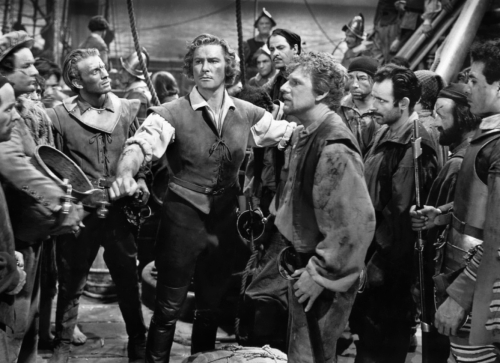
The Quiet Man is one of my favorite films, not just to watch for St. Patrick’s Day, but for all time. The teaming of Maureen and John Wayne is one of the few on screen castings that actually deserves the title of “electric.” Since TCM decided to give The Quiet Man a miss for the lineup today, head over to YouTube, where a very kind soul has uploaded the film in its entirety.

4 Comments

Filed under Classic Movies

Cadmium Yellow, Blood Red Bookcover

**trumpet fanfare, please**

It is my honor to announce the unveiling of a new e-bookcover design (created by me) for Jacqueline T. Lynch’s detective series! Cadmium Yellow, Blood Red has just been republished with the new cover on Amazon, Barnes & Noble and Smashwords. This is the first book in the Double V Mystery series. Set in 1950s Connecticut, it centers on an unlikely pair of amateur sleuths, thrown together because of a murder. Hop over to Jacqueline’s blog for a peek at the first chapter, brilliantly illustrated with classic film screen caps. I wish all books could be illustrated this way.

I had so much fun designing this cover and the logo for Double V. It’s a dream come true for me to create a cover for a Noir-inspired series. And I must admit, I genuinely squealed to see a piece of art I designed load on a real life Amazon page. :)

Heartfelt thanks to Jacqueline for giving me this truly thrilling opportunity.

6 Comments

Filed under My Art

Bradford Dillman, Villain Extraordinaire

As you have no doubt realized by now, I am a staunch supporter of the creative endeavors of my pals*. Not just because they are my special chums and I love them, but because these gals are enormously talented, each in their own way.

Today I’d like to share The Bradford Dillman honorary blogathon – the annual project of my dear friend The Millie. This year’s collection of posts rallies under the moniker: Bradford Dillman: A Jazzier Kind of Noir. Don’t know who Bradford Dillman is or why he deserves a blogathon? Well, as the official hostess and organizer of these Bradford festivities, Millie created a short video promotion that is sure to clear up any questions. Have a look:

After laughing till I cried at that hilarious promo, I became determined to participate this year. As I set about searching the filmography of Mr. Dillman, I found a film just tailor-made for a blogathon hosted by The Millie: The Great Gold Conspiracy aka Gold (1974). This is not a film I would typically watch (my main rule is to steer clear of films made after 1968, especially ones from 1969-1979), but I braved Gold for the sake of Bradford Dillman.

Gold takes a harsh look at the complex workings of an African goldmine. Riddled with ulterior motives, back-stabbing, racism and intrigue, the management team of the mine works through a disastrous accident in the first minutes of the film. At the root of all the trouble is none other than our friend Bradford. He has cooked up a plot to sabotage the mine for profit and is determined to see it through. We have fistfights, extra-marital affairs, dirty dealing and two (not just 1, but 2!) mine collapses.
Let’s just do a quick rundown on the vital statistics here:

1. Bradford Dillman in a prominent villain’s role. Just look at that troubled expression.

2. Interesting, if almost kooky theme and end music. A textbook example of 70′s imagery and sounds, right down to the tune at the end credits with lyrics sung by Jimmy Helms.

3. An almost unbelievable all-star cast.

Roger Moore in full James Bond mode – almost always found in carelessly unbuttoned shirts.

Ray Milland as an American tycoon, complete with cigar and corporate snarl.

John Gielgud, Bradford’s partner in corruption.

Susannah York- too old for pigtails, but sporting them nonetheless. This poor lady really got the shaft from wardrobe on this film. Not a single redeemable outfit in the bunch. In fact, when she dines with Roger Moore, she’s clad in what appears to be a large sheer curtain, gathered strategically.

[Warning - SPOILERS AHEAD!]

And the best for last, #4 – Bradford Dillman’s epic final scene…

…death by Rolls Royce. Honestly, this scene (which clocks in at a mere 3 minutes) trumps every other memorable event in the film (including two mine collapses and Susannah York landing a small plane on a tiny dirt road near the mine entrance). The scene only gains epic status because the object of wrath is Bradford Dillman. After he has spent the entire film scheming, double-dealing and lying to all and sundry, he finally meets his end flying through the air in a cloud of dust.

The only drawbacks for me are the needless gore (Oh, you didn’t want to see Roger Moore’s limbs get crushed? So sorry) and the level of risque elements. On my risque scale of 1-10, I’d give this film a 8.5 for situations and language. But prejudice against the 70s and cinematic gripes aside, I must admit Gold is a highly enjoyable film. It won’t be joining the ranks of my DVD shelf any time soon, but I wouldn’t have missed the performance of Bradford Dillman for the world. He really is a deliciously evil villain!

[End SPOILERS]

Gold is available for viewing on Amazon’s Instant Video or free on YouTube. (To see Bradford’s incredible final scene, watch from 1:51:00. Susannah’s curtain dress is at 43:00.)

*In case you don’t know, my pals are Kate, Millie, Nicole & Sarah

4 Comments

Filed under Movie Review

Movie Review: Love Letters (1945)

Redesigned movie poster created by Casey Koester - all rights reserved. Copyright 2009.(redesigned movie poster by yours truly – ©2009)

At first glance, 1945′s Love Letters appears to be a glossy, run-of-the-mill wartime love story. Starring Joseph Cotten and Jennifer Jones in their first romantic pairing (a full 3 years before Portrait of Jennie), the film is a mesmerizing, perplexing, layered work that defies genre categorization. The love story is definitely there, but the film also has elements of Noir, straight up mystery and courtroom drama.

The tale begins innocently enough – when a handsome, arrogant, unlettered solider named Roger Morland (Robert Sully) meets a girl he wishes to impress (Jennifer Jones) he enlists his comrade in arms, Alan Quinton (Joseph Cotten) to write love letters to the girl in his name. Alan agrees, against his better judgement, and finds a kindred spirit in Victoria. The two share a friendship that is unlike anything he has known before. When the war ends, Alan and Roger part company and lose track of each other, but Alan never forgets the sweet, understanding girl who corresponded with him as he masqueraded as Roger. When Alan’s aunt passes away and wills her lonely country cottage to him, he takes the opportunity to spend time by himself to sort out the happenings of the war, especially his feelings for Victoria. But it just so happens this cottage is located near the small English village where Alan sent the letters to Victoria, so he embarks on a mission to find out what happened to her and Roger. And he isn’t prepared for what he uncovers.

The supporting cast list reads like a Who’s Who of character actors: Cecil Kellaway, Gladys Cooper, Reginald Denny, Anita Louise and (my personal favorite) Ann Richards. Ann Richards plays Victoria’s calm, wise and mysteriously prophetic friend Dilly – a character with some of the best lines in the whole film. Anita Louise is Alan’s social climbing girlfriend whose attitude about his wartime hardships is surprisingly cold, detached and uncaring. It’s an impressive performance that deserves more appreciation and recognition. It astounded me the first time I saw it because I’m used to seeing Anita Louise as a loveable, sweet-tempered girl.

The original novel entitled Pity My Simplicity was written by Christopher Massie in 1944. When Paramount decided to make the book into a film, Ayn Rand took on the task of writing the screenplay. Yes, you read that right – Ayn Rand of Objectivism, The Fountainhead and Atlas Shrugged fame. She spent a few years in Hollywood working as a screenwriter for Hal Wallis’ production company while she wrote the screenplay for The Fountainhead (source). Because I’m a big fan of the film, I decided to hunt down Chris Massie’s book and find out how much of the plot was his writing. After all, if the story I liked was his, it was a good bet his other works would be worth reading.

Well, Ayn Rand said it best: “The novel on which the picture was based was a holy mess.” There isn’t a bit of understatement in that sentiment. Chris Massie’s novel is full of superfluous supporting characters who muddy the plot and make it impossible to follow. The Joseph Cotten character lacks any sort of appeal. He is selfish, self-pitying, childish and even worse, his name in the book is Maurice. The novel is needlessly tear-jerky, to the point of being laughable. A long scene involving a mirrored-wall room filled with pillows and balloons (mercifully omitted in the screenplay) qualifies as gibberish. And the ending infuriated me to such an extent, I fumed and raved about the injustice of it for a full hour. If I had read the book before seeing the film, I would have avoided the film at all costs. I realized that the parts of the film I enjoyed the most – the brilliant, insightful dialogue about life, love and human relations – were all Ayn Rand’s additions. She eliminated the characters who confused the story, created the role for Cecil Kellaway (his character is a woman in the book) and bolstered the Dilly character into the strong, confident woman I admire.

When the film premiered, critics took an instant dislike to the effort. Bosley Crowther (what a name!) writing for the New York Times dismissed the film as “sentimental twaddle,” pronounced William Dieterle’s direction as “mushy and pretentious” and described Jennifer Jones’ performance as “a tipsy high school school girl who has smelled the cork once too often and is all giggly and loose at the joints.” Hmm. Sour grapes, Mr. Crowther?

Despite Mr. Crowther’s scathing opinion, Love Letters remains in an honored place at the top of my favorite films list ever since I first saw it on TCM years ago. The combination of the stellar cast, engaging plot and memorable lines keeps me coming back to it over and over again.

Little Extras

The song Love Letters (sung by Dick Haymes above) does not appear with lyrics in the final print of the film, but this version was released the month after the film and rose to #11 on the Billboard chart.

Be on the lookout for the first scene where Joseph Cotten writes a letter. The handwriting pictured is rumored to belong to David O. Selznick himself. (Screencap above belongs to Jacqueline T. Lynch of Another Old Movie Blog. Check out her fascinating in-depth post on Love Letters here.)

TCM is playing Love Letters again for the first time since I recorded it – tonight (Saturday, January 21, 10pm EST). Set your recorders folks – don’t miss this under appreciated gem!

6 Comments

Filed under Movie Review

A Big Announcement!

*drum roll please!* Big news today!

My dear friend Kate asked me to join her blog design business, Scathingly Brilliant Blog Design! Together, we can offer design support for both Blogger and WordPress. Kate will continue to handle the Blogger designs as she has been, and I’ll be designing WordPress layouts as an added feature! And blog design isn’t all we can do – check out the full range of design options (everything from illustrated portraits to Etsy banners) on the splendid site Kate developed here.

(And hey, isn’t that header up there beyond incredible? Kate created it. She’s a seriously talented gal!)

Leave a Comment

Filed under me

Gossip with The Women

1939′s The Women bestowed a wealth of gloriously iconic dialogue and imagery on the world. Rosalind Russell’s “Seeing Eye” Blouse designed by Adrian, Rosalind and Phyllis Povah landing heads-first into a passing department store cart and my personal favorite: “Jungle red!”

But there is one disconcerting aspect of the film I could never find an explanation for…until now. The poodle-like hairstyles. Every woman in the production (except the blissfully spared Paulette Goddard) sports an unbecoming mass of tightly woven curls on her head. If any of the ladies had long hair at the time, it’s well disguised and contained with the most permanent of waves ever to grace a screen.

Well, it seems at least one of the ladies has a practical reason for her poodle curls, according to the gossip column of Silver Screen’s August 1939 issue:

Joan had every right to be “horrified” if you ask me. Even the masterful snips and curls of Sidney Guilaroff couldn’t transform her botched perm into an acceptable hairstyle. I can’t help wondering if the rest of the ladies’ hair was styled to match Joan’s just so her chopped locks would not stand out. And then I started wondering why Paulette Goddard sported soft shoulder length tresses while the others went for the chop? My only explanation is that it really paid to be married to Charlie Chaplin!

The same column leaked a tidbit about Adrian’s shocking fashions, too. If those clothes in the fashion show sequence are still fascinating and slightly odd to this day, imagine what movie-goers thought of them at the time. No wonder Silver Screen attempted to prepare everyone:

Joan is seriously displeased with the new do.

9 Comments

Filed under Classic Movies

Snood Perfection for the Unconvinced

If my dual tutorials (1, 2) have not been enough to convince you, my dear readers, of snood excellence, I present a final piece of imagery: the beautiful and talented Beth Riesgraf in the most recent episode of Leverage.

As Parker, Beth dons a gorgeous range of outfits – sweaters from Anthropologie, hats of all descriptions, blouses with peter pan collars and sometimes even fluffy feathered dresses, but the black lace snood and matching dress above are my favorites by far.

It also helps that Beth wore this outfit for perhaps the most “classic Parker” moment of this season:

ELIOT: Did you take a bite of all these?
PARKER: Well, I had to see which one I wanted.

**a big thank you to leverage-caps.tumblr.com and fishnightlight.tumblr.com for screencapping the episode so meticulously**

2 Comments

Filed under Fashion Backward